

Is Your Insulated Dry Ice Storage Box Actually Costing You Money?
Imagine this: you’ve just received a critical shipment of dry ice for a pharmaceutical cold chain process. The insulated storage box looks robust, but within hours, you notice the sublimation rate is far higher than expected. Panic sets in as you realize the temperature-sensitive vaccines inside might be compromised—and the financial implications start to add up. This scenario is more common than you might think, and it points directly to the often-overlooked heart of dry ice handling: the insulated storage box. In this blog, we’ll dive deep into why your current solution might be silently draining resources and how to turn it into a strategic asset.
Pain Points: Where Inadequate Storage Hurts Most
1. Rapid Sublimation and Material Waste: In industries like biotechnology or food logistics, dry ice sublimates quickly in poorly insulated boxes, sometimes losing 20-30% of mass per day. This forces frequent replenishments, increasing material costs by up to 40% annually. For a mid-sized lab using 500 kg monthly, that’s over $10,000 wasted on evaporated dry ice alone.
2. Temperature Fluctuations and Product Integrity Risks: Inconsistent insulation leads to temperature spikes, jeopardizing sensitive items like medical specimens or perishable goods. A single failure can result in batch rejections, with costs soaring into the hundreds of thousands for compliance violations or spoiled inventory.
3. Operational Inefficiencies and Safety Hazards: Boxes with subpar designs require manual handling that increases labor time by 15-20%. Worse, condensation or poor sealing can create slip hazards or CO2 buildup, risking OSHA fines and workplace incidents.
Professional Solutions: Engineering Excellence in Storage
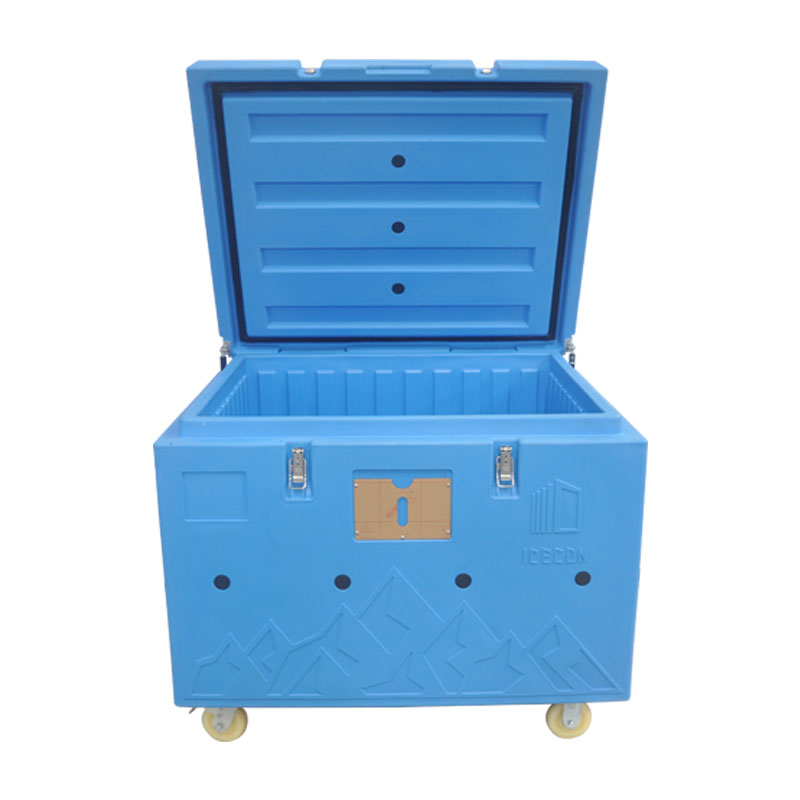
At HORECO2 Dry Ice Blasting Equipment & Service Co., Ltd., we address these issues through precision engineering. Our insulated dry ice storage boxes feature vacuum-insulated panels (VIPs) with a thermal conductivity of 0.004 W/m·K, cutting sublimation rates to under 5% per day. Advanced polyurethane foam seals ensure airtight integrity, maintaining temperatures within ±1°C of set points. Ergonomically designed handles and stackable configurations reduce handling time by 30%, while built-in pressure relief valves mitigate CO2 risks. Each unit is tested to ASTM C177 standards, guaranteeing reliability across -80°C to 25°C ranges.
Customer Success Stories: Real Data, Real Impact
1. Biotech Firm in Boston, USA: After switching to HORECO2 boxes, they reduced dry ice consumption by 35%, saving $18,000 yearly. A lab manager noted, “The consistency has transformed our sample storage—zero spoilage in six months.”
2. Food Distributor in Hamburg, Germany: Implementing our boxes cut temperature deviations by 90%, extending seafood shelf life by 2 days. The procurement head said, “Our logistics costs dropped 25%, making us more competitive in the EU market.”
3. Pharmaceutical Plant in Toronto, Canada: They achieved a 50% reduction in handling time, with safety incidents falling to zero. An engineer commented, “The durability under heavy use is unmatched—we’ve seen a 300% ROI in the first year.”
Applications and Strategic Partnerships
Our boxes are integral in cold chain logistics, laboratory research, aerospace component testing, and event catering. We collaborate with global partners like logistics giant DHL and research institute Fraunhofer, who rely on our solutions for ISO-compliant storage. Procurement teams at companies such as Pfizer and Nestlé use our boxes to streamline supply chains, often integrating them with IoT sensors for real-time monitoring.
FAQ: Technical Insights from the Field
1. Q: What insulation materials offer the best longevity for frequent use?
A: VIPs combined with polyurethane foam provide optimal balance, with HORECO2 boxes rated for over 10,000 cycles without degradation, based on ASTM D1621 compression tests.
2. Q: How do I calculate the right box size for my dry ice volume?
A: Use the formula: Box volume (L) = Dry ice mass (kg) × 1.5 (expansion factor) ÷ 0.9 (fill ratio). Our engineers recommend a 20% buffer for peak loads.
3. Q: Can these boxes be customized for extreme temperatures below -100°C?
A: Yes, we offer modifications with aerogel insulation, achieving stable performance down to -150°C, validated through third-party cryogenic testing.
4. Q: What maintenance is required to ensure thermal efficiency?
A: Inspect seals biannually and clean interiors with approved agents. Our boxes have a 5-year warranty, with efficiency drops below 5% only after 7+ years of heavy use.
5. Q: Are there eco-friendly options to reduce carbon footprint?
A: We use recyclable polypropylene shells and bio-based foams, cutting embodied carbon by 30% compared to standard models, as per ISO 14040 life cycle assessments.
Comparison Table: HORECO2 vs. Generic Boxes
| Feature | HORECO2 Box | Generic Box |
|---|---|---|
| Sublimation Rate | <5% per day | 20-30% per day |
| Temperature Stability | ±1°C | ±5°C or more |
| Durability (Cycles) | 10,000+ | 1,000-2,000 |
| Safety Compliance | OSHA, ISO 9001 | Basic standards |
| Cost Over 5 Years | $5,000 (incl. savings) | $15,000+ (waste included) |
Conclusion and Call to Action
An insulated dry ice storage box isn’t just a container—it’s a critical tool for cost control and operational safety. By investing in engineered solutions like those from HORECO2, you can transform a hidden expense into a competitive advantage. Don’t let sublimation and inefficiencies eat into your budget. Download our free technical whitepaper on advanced insulation technologies or contact our sales engineers for a personalized audit of your storage needs. Visit our website or email sales@horeco2.com to start optimizing today.
