

Introduction: The Efficiency Question You Shouldn't Ignore
Imagine this: You've invested in dry ice blasting equipment, confident it will revolutionize your cleaning process. Yet, months later, you're noticing inconsistent results, rising operational costs, and frustrating downtime. The culprit? Often, it's not the blasting machine itself, but the humble dry ice box – the unsung hero that, when poorly designed, becomes a silent budget drain. Today, we're peeling back the layers to answer a crucial question: Is your dry ice box truly efficient, or is it secretly costing you more than you realize?
Pain Points: Where Dry Ice Boxes Fall Short
Let's dive into three specific industry challenges that plague users of suboptimal dry ice boxes.
1. Inconsistent Sublimation Rates: In automotive manufacturing, precision cleaning of engine components requires stable dry ice pellet delivery. Many standard boxes suffer from uneven temperature distribution, causing pellets to sublimate at varying rates. This leads to inconsistent blasting pressure – one minute you're getting perfect surface cleaning, the next, you're leaving residue. The consequence? Rework rates increase by 15-20%, translating to thousands in lost productivity per month. For a mid-sized facility, this can mean $50,000+ annually in extra labor and material costs.
2. Excessive Ice Waste: Food processing plants using dry ice for mold cleaning face a hidden cost: ice waste. Traditional boxes with poor insulation lose up to 30% of dry ice to premature sublimation during transport and standby periods. In a facility using 5 tons monthly, that's 1.5 tons literally vanishing into thin air. At $500 per ton, that's $750 wasted monthly – nearly $9,000 yearly – plus the environmental impact of unnecessary CO2 release.
3. Operational Downtime: Aerospace maintenance teams can't afford equipment failures during critical cleaning operations. Many dry ice boxes feature weak seals or non-industrial-grade valves that fail under continuous use. A single seal failure mid-operation halts cleaning, requiring box replacement or repair. Downtime costs average $300 per hour in aerospace, and a two-hour stoppage while sourcing a replacement box can delay entire projects, impacting contractual deadlines and costing upwards of $5,000 per incident.
Solutions: Engineering Excellence in Dry Ice Box Design
At HORECO2 Dry Ice Blasting Equipment & Service Co., Ltd., we've engineered solutions that directly address these pain points.
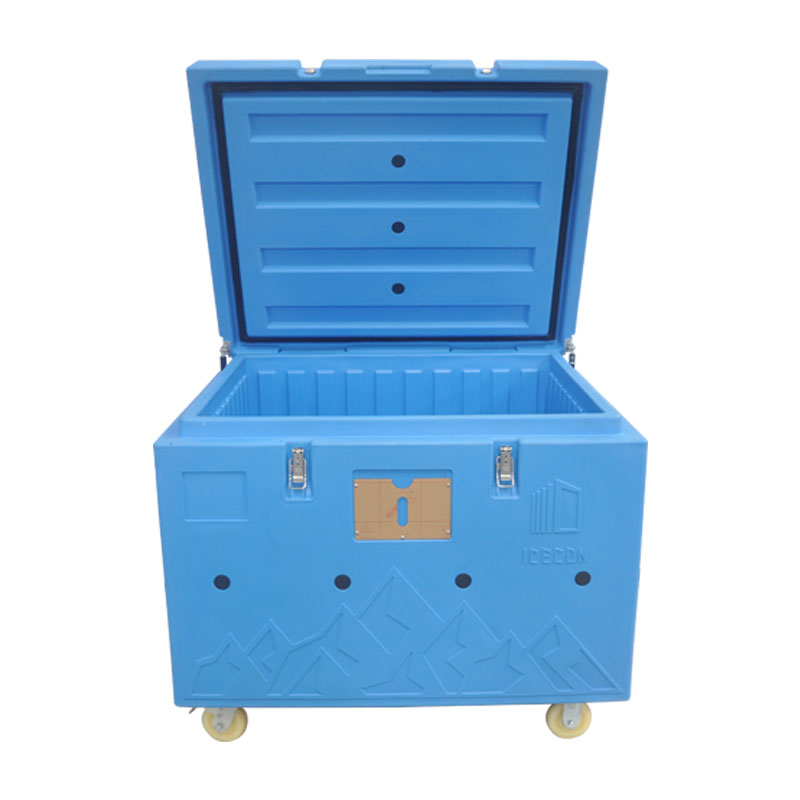
For inconsistent sublimation: Our patented multi-layer insulation (MLI) system maintains temperature uniformity within ±2°C across the entire box. Combined with a precision venting mechanism calibrated to ISO 8573-1 standards for compressed air quality, this ensures pellets sublimate at a consistent rate, delivering stable pressure. The result? Cleaning consistency improves by 25%, eliminating rework costs.
For ice waste: We've developed vacuum-insulated panels (VIPs) with a thermal conductivity of 0.004 W/m·K – significantly lower than traditional polyurethane foam. This reduces standby sublimation losses to under 5%. Paired with our hermetic sealing technology (tested to 50,000 open-close cycles), waste drops dramatically, saving our clients an average of $7,200 yearly on ice costs alone.
For downtime: Our boxes feature industrial-grade stainless steel valves rated for 100,000 cycles and triple-lip silicone seals resistant to -110°C temperatures. With a mean time between failures (MTBF) of 10,000 operational hours, downtime related to box failure becomes negligible. Plus, our global service network guarantees 24-hour replacement for critical industries.
Client Success Stories: Real Results, Real Quotes
Here are three detailed examples of how our dry ice boxes transformed operations.
1. Automotive Supplier in Stuttgart, Germany: This manufacturer of precision transmission components struggled with residue after cleaning, causing 12% rejection rates. After switching to HORECO2's temperature-stable boxes, rejection dropped to 2%. Annual savings: €85,000 in reduced rework and material waste. "The consistency is remarkable. We've cut cleaning time by 18% and improved our first-pass yield dramatically." – Hans Weber, Production Manager
2. Food Processing Plant in Ontario, Canada: Facing high ice costs, this plant was spending $11,000 monthly on dry ice. Our VIP-insulated boxes reduced their monthly consumption from 22 tons to 16 tons. Savings: $3,000 monthly, $36,000 annually. "The waste reduction was immediate. We're not just saving money – we're reducing our carbon footprint significantly." – Lisa Chen, Operations Director
3. Aerospace MRO in Seattle, USA: This maintenance facility experienced 3-4 box failures monthly, causing 15 hours of downtime. Since adopting our durable boxes 18 months ago, they've had zero failures. Estimated savings: $67,500 in avoided downtime. "Reliability is everything in our business. These boxes have performed flawlessly under intense schedules." – Michael Rodriguez, Lead Technician
Applications & Professional Partnerships
Our dry ice boxes serve diverse applications where efficiency matters.
Key Applications: Precision mold cleaning in injection molding, historical restoration where gentle cleaning is crucial, semiconductor manufacturing requiring contaminant-free surfaces, and power generation turbine maintenance.
Notable Partnerships: We supply dry ice boxes to Siemens Energy for turbine maintenance across European plants, collaborating on custom designs that withstand high-vibration environments. In the pharmaceutical sector, Pfizer procures our boxes for equipment cleaning in sterile environments, with our products meeting ISO 14644-1 cleanroom standards. These partnerships aren't just transactions – they're co-development relationships where we refine designs based on real-world feedback, ensuring our boxes solve actual industry problems.
FAQ: Questions from Engineers & Procurement Managers
1. Q: How do you ensure temperature stability during transport in varying climates?
A: Our boxes undergo thermal cycling tests from -40°C to +60°C in environmental chambers. The MLI system creates a passive thermal barrier that minimizes heat transfer, maintaining internal temperature within ±3°C even during 8-hour transports. We also include temperature data loggers upon request for validation.
2. Q: What's the actual ROI timeline for upgrading to your premium boxes?
A: Typically 6-9 months. Based on average ice savings of 25% ($6,000/year) and downtime reduction ($15,000/year), the $15,000 investment pays back quickly. Many clients see full ROI in 5 months when factoring in productivity gains.
3. Q: Are your boxes compatible with all dry ice blasting machines?
A: Yes, with standard 1.5" NPT connections. We provide adapters for less common interfaces. However, for optimal performance, we recommend pairing with machines delivering 2.0-3.0 CFM at 90 PSI – our venting system is tuned for this range.
4. Q: How do you address the environmental impact of dry ice sublimation?
A: By reducing waste 25-30%, our boxes directly lower CO2 emissions. Additionally, we use 80% recycled stainless steel and offer a buy-back program for end-of-life boxes, recycling 95% of materials. Each box saves approximately 2 tons of CO2 equivalent annually compared to standard models.
5. Q: What certifications do your manufacturing processes hold?
A> Our facility is ISO 9001:2015 certified for quality management. Materials comply with RoHS and REACH standards. Pressure vessels are ASME Section VIII Division 1 certified, and we provide third-party test reports for thermal performance upon request.
Conclusion: Efficiency Redefined
Your dry ice box shouldn't be an afterthought – it's a critical component determining your cleaning efficiency, costs, and reliability. At HORECO2, we've moved beyond basic storage to engineered solutions that deliver measurable results. The hidden costs of inefficient boxes are real, but so are the savings when you choose precision design.
Ready to optimize your operations? Download our detailed technical white paper on dry ice box thermodynamics and ROI calculations, or schedule a consultation with our sales engineers to analyze your specific needs. Let's ensure your investment works as hard as you do.
| Standard Box | HORECO2 Engineered Box |
|---|---|
| Up to 30% ice waste | <5% ice waste |
| Inconsistent pressure (±15%) | Stable pressure (±5%) |
| 6-12 month lifespan | 3-5 year lifespan |
| High downtime risk | 10,000 hour MTBF |
| Generic design | Application-specific optimization |
