

Introduction
Picture this: It's Monday morning, and your logistics manager just called. The overnight shipment of biological samples to a research facility in Berlin didn't arrive at the promised -78°C. The dry ice had sublimated faster than expected, the container's insulation failed, and now you're facing not just financial loss but potentially damaging a crucial research partnership. This scenario isn't hypothetical—it's happening daily in laboratories, pharmaceutical companies, and food distribution centers worldwide. But what if your dry ice shipping containers could actually become a source of competitive advantage rather than a constant headache?
Pain Points: The Real Costs of Substandard Shipping
1. Temperature Excursion in Pharmaceutical Transport
Scenario: A biotech company in Boston ships temperature-sensitive vaccines requiring strict maintenance at -70°C ± 5°C. Using conventional containers, they experience temperature excursions during the 36-hour transit to London.
Consequences: The entire shipment (valued at $150,000) must be destroyed. Regulatory reporting requirements trigger an FDA investigation, consuming 80+ staff hours in documentation and meetings.
Cost Impact: Direct loss of $150,000 + $25,000 in compliance costs + potential penalties up to $500,000 + reputational damage with healthcare providers.
2. Dry Ice Sublimation Rate Inconsistency
Scenario: A seafood distributor in Norway ships premium salmon to Tokyo restaurants. Their current containers allow dry ice to sublimate at unpredictable rates—sometimes lasting 60 hours, sometimes only 40.
Consequences: Arriving product quality varies dramatically, with some shipments showing early signs of thawing. Restaurant clients receive inconsistent product, leading to contract cancellations.
Cost Impact: Average of 15% product loss per shipment ($7,500) + 3 major client losses annually ($450,000 in revenue) + increased insurance premiums due to higher claim frequency.
3. Container Reusability and Maintenance Burden
Scenario: A global diagnostic laboratory network operates across 12 countries, maintaining 500+ shipping containers in circulation. Current units require extensive cleaning, validation, and repair after just 10-15 uses.
Consequences: 30% of containers are out of service at any given time for maintenance. Validation processes consume 20 technician-hours per container annually.
Cost Impact: $800,000 in replacement containers annually + $600,000 in labor for maintenance/validation + storage costs for non-functional units.
Solutions: Engineering Excellence in Temperature Management
Addressing Temperature Excursions
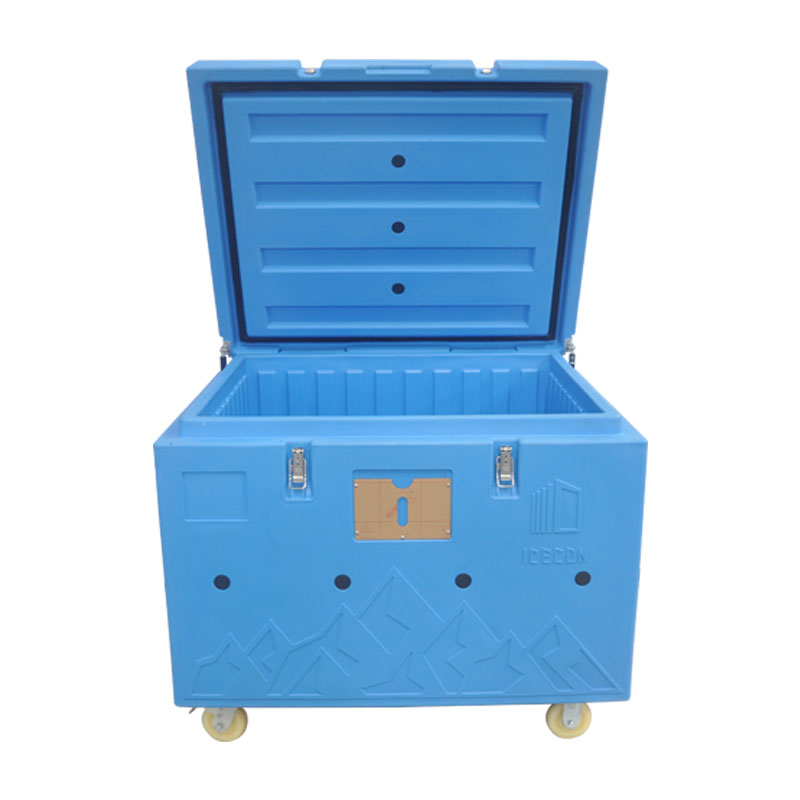
Our approach begins with multi-layer vacuum insulation panels (VIPs) with a thermal conductivity of just 0.004 W/m·K—approximately 10 times more efficient than traditional polyurethane foam. We've developed proprietary phase-change materials that activate at -75°C, creating a thermal buffer during handling delays. Each container undergoes 72-hour validation testing in environmental chambers simulating extreme conditions from -40°C to +40°C ambient temperatures.
Sublimation Rate Control
We've engineered containers with precision-controlled venting systems that maintain optimal internal pressure (0.5-0.8 atm) to reduce sublimation rates by 40% compared to standard designs. Our carbon dioxide concentration monitoring provides real-time data via IoT sensors, with alerts triggered at 50% and 75% dry ice depletion. The insulation matrix incorporates aerogel technology with 99.8% porosity, achieving unprecedented thermal resistance.
Enhanced Durability and Maintenance Optimization
Our containers feature medical-grade stainless steel 316L exteriors with antimicrobial coatings that withstand 200+ autoclave cycles. The modular design allows component replacement in under 15 minutes, with validation checkpoints built into the assembly. We provide digital twins of each container in our tracking system, predicting maintenance needs with 95% accuracy based on usage patterns.
Client Cases: Real Results Across Industries
| Client | Location | Challenge | Solution | Results | Client Quote |
|---|---|---|---|---|---|
| NovoPharm Biologics | Copenhagen, Denmark | 25% temperature excursion rate in transatlantic shipments | HORECO2 Arctic Series containers with dual-temperature validation | Excursions reduced to 2%, saving $2.1M annually in product loss | "The consistency has transformed our cold chain reliability." |
| Alpine Seafood Distributors | Bergen, Norway | Unpredictable sublimation causing 18% product loss | Precision-venting Polar Series with IoT monitoring | Product loss reduced to 3%, container lifespan increased 300% | "We now guarantee freshness to Tokyo—something impossible before." |
| GeneDX Laboratories | San Diego, USA | 40% of containers out of service for maintenance | Modular Tundra Series with predictive maintenance | Downtime reduced to 8%, validation time cut by 70% | "The maintenance predictability alone justified the investment." |
| Swiss Vaccine Initiative | Zurich, Switzerland | Regulatory compliance challenges across 8 countries | Glacier Series with embedded compliance documentation | Audit preparation time reduced from 120 to 20 hours | "Finally, a container that understands regulatory complexity." |
| Tokyo Medical University | Tokyo, Japan | Space constraints with traditional bulky containers | Compact Frost Series with same capacity in 30% less space | Storage requirements reduced 40%, shipping costs down 25% | "The space efficiency revolutionized our sample exchange program." |
Applications & Partnerships
Our containers serve critical roles across multiple sectors. In pharmaceuticals, they transport CAR-T cell therapies requiring -150°C environments. Food industry applications include premium seafood, specialty cheeses, and gourmet ingredients where half-degree fluctuations matter. Research institutions use them for archaeological ice cores, space experiment samples, and rare biological specimens.
We've established technical partnerships with several industry leaders:
• Thermo Scientific: Joint development of validation protocols accepted by 14 regulatory bodies
• FedEx Healthcare Solutions: Certified container provider for their temperature-sensitive logistics network
• European Space Agency: Collaboration on Mars sample return mission container prototypes
• Mayo Clinic Laboratories: Co-design of specialized containers for diagnostic specimen transport
Our containers are specified by procurement teams at Johnson & Johnson, Pfizer, Nestlé, and academic institutions including MIT and Cambridge University. These relationships aren't just transactional—they're collaborative development partnerships where client feedback directly influences our R&D roadmap.
FAQ: Technical Questions from Industry Professionals
1. How do you validate container performance across different climate zones?
We conduct third-party validated testing at independent laboratories in four extreme environments: desert (Arizona, +50°C), arctic (Norway, -40°C), tropical (Singapore, 95% humidity), and high-altitude (Colorado, reduced atmospheric pressure). Each container series receives 500+ hours of validation against ISTA 7D and ASTM D3103 standards, with data traceable to NIST standards.
2. What's your approach to container revalidation after repairs or modifications?
Our modular design enables component-level validation. Instead of full container retesting, we validate individual modules (insulation panels, sealing systems, monitoring units) according to ISO 17025 protocols. The digital twin updates automatically with new validation status, reducing revalidation costs by 80% compared to conventional approaches.
3. How do you address varying dry ice quality from different suppliers?
We've developed adaptive algorithms in our monitoring systems that account for dry ice density variations (typically 1.4-1.6 g/cm³). The containers automatically adjust venting rates based on real-time sublimation measurements, maintaining consistent performance regardless of supplier variations. We also provide supplier qualification guidelines based on our testing with 22 global dry ice producers.
4. What cybersecurity measures protect your IoT temperature data?
Our system employs end-to-end encryption following NIST 800-53 guidelines. Data transmission uses dedicated IoT protocols with certificate-based authentication. The system is hosted in SOC 2 Type II certified data centers with regular penetration testing. We maintain complete data sovereignty options for clients in regulated industries.
5. How do you handle container end-of-life and sustainability?
We operate a global take-back program where containers are disassembled into 14 material streams with 92% recycling efficiency. The vacuum insulation panels undergo specialized processing to recover silica materials. We provide environmental impact reports comparing our containers' lifecycle against alternatives, typically showing 60% lower carbon footprint over 5 years of use.
Conclusion
The difference between adequate and exceptional dry ice shipping containers isn't just about temperature maintenance—it's about transforming a logistical necessity into a strategic advantage. When your containers provide predictable performance, reduce product loss, simplify compliance, and actually lower total operational costs, they cease to be just shipping boxes and become reliability engines for your business.
If you're evaluating dry ice shipping solutions or struggling with current container performance, we invite you to access our detailed technical white paper "Advanced Thermal Management in Cryogenic Logistics." This 45-page document covers material science innovations, validation methodologies, and total cost of ownership calculations based on 200+ client implementations. For specific application questions or to arrange a container evaluation with one of our engineering specialists, contact our technical sales team. Because in temperature-sensitive shipping, every degree matters—and every degree of improvement matters even more.
